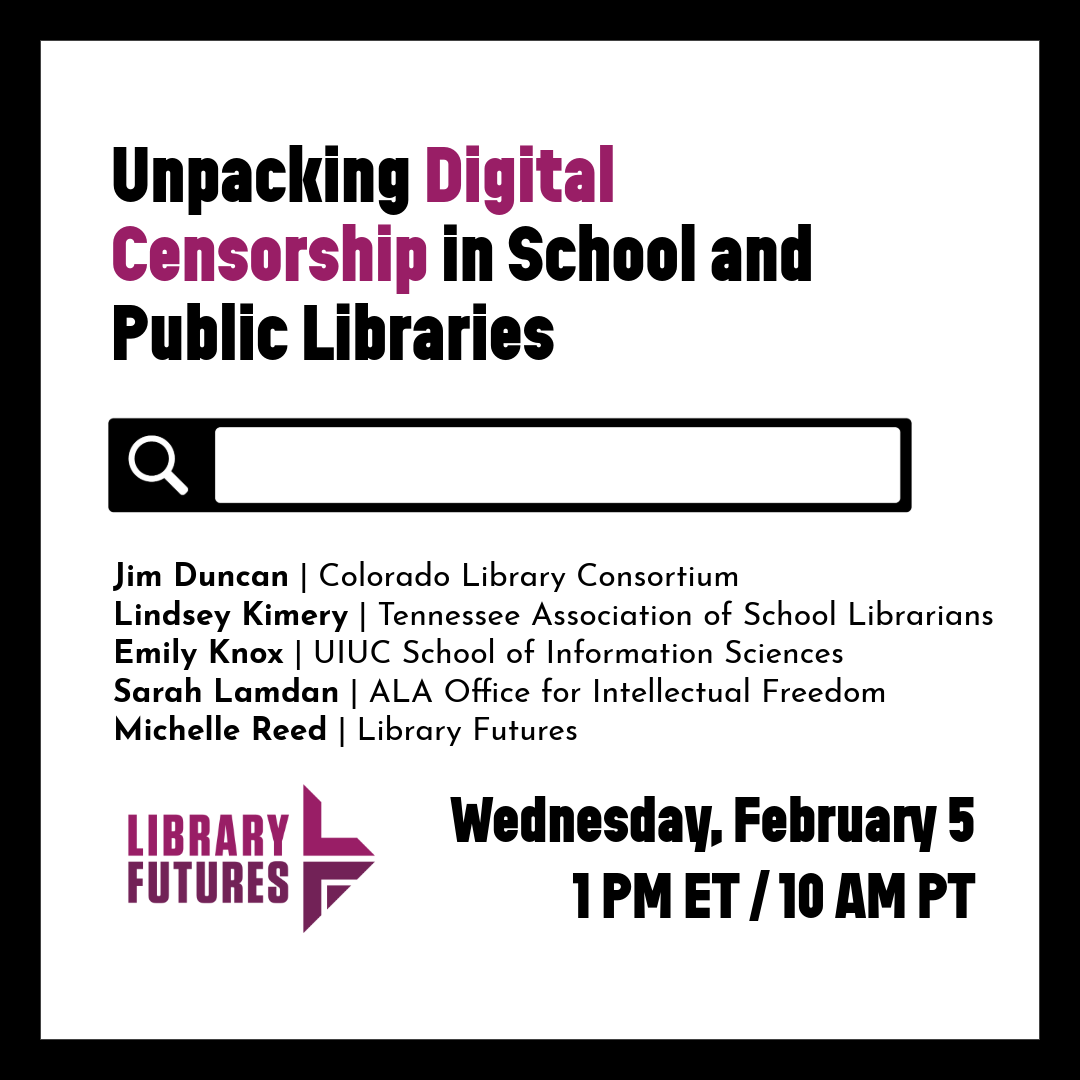
Unpacking Digital Censorship in Schools and Libraries
Library Futures hosted a distinguished panel of practitioners, researchers, and policy experts for Unpacking Digital Censorship in Schools and Libraries, a discussion that explored and uncovered the past, present, and future of digital censorship and intellectual freedom.
Jim Duncan of the Colorado Library Consortium, Lindsey Kimery of the Tennessee Association of School Librarians, Emily Knox of the UIUC School of Information Sciences, and Sarah Lamdan of the ALA Office for Intellectual Freedom joined Michelle Reed, Director of Programs at Library Futures, for an overview of digital censorship in school and public libraries, including legislative attempts to ban content. In addition to a robust discussion of their research and first-hand experiences, they discussed a forthcoming report from Library Futures that dives into this underreported area of library censorship: database bans that restrict youth access to e-books, research resources, and other digital content.
These challenges and bans, and the machinations behind them, are a form of neo-censorship: a model of censorship that seeks to control information and opinion by blocking access in ways that are often invisible and insidious. In a time of increased challenges to intellectual freedom, it is even more important that we understand the real threats posed by neo-censorship. Our panelists have ground-level and policy experience in key areas to aid understanding digital censorship today: addressing database bans, handling reports of pornography in library materials, and working with state-level legislation related to digital content in libraries.
The webinar was not recorded, but Library Futures intern Mia Jakobsen provided a write-up and reflection on the event.